Mostrando postagens com marcador philosophy. Mostrar todas as postagens

domingo, 24 de agosto de 2014

Intelligence is one's capacity to predict the future

I've been using this definition a lot, lately. Can't remember who told me first or where I saw it first. Wikipedia says Intelligence has been defined in many different ways such as in terms of one's capacity for logic, abstract thought, understanding, self-awareness, communication, learning, emotional knowledge, memory, planning, creativity and problem solving. But without future accomplishments, how can you measure any of it?

As far as my limited intelligence can tell, the brain ( <-- many important videos there ) is still the most intelligent machine we know of. But it has a purpose. And one purpose only: generating movement. If you don't understand this, go ahead and watch the video!


Hitting a baseball is a very simple instance of that. It has to capture an image of a ball coming at a quite good speed, calibrate every muscle in the body to twist in a way to hit that ball with maximum power and give the hitter enough time to run across a big field before someone else brings the ball back. It generated a lot of movement and so complex ones we can barely reproduce them with robots. It's making small predicting calculations all the time, from what the pitcher might be thinking to actually predicting the ball's path after watching its movements, to dodging each base into a home run.

And how does that extrapolates to logic, memory, emotional knowledge, etc?

Being such a complex machine, it ended up malfunctioning. Like any other evolution mutation. Most are not useful. This was. (I'm not sure this is what happened, but I'm pretty sure it could have and at least something similar did): By abstracting the nature, we were able to predict when a tree would be fruitful and then start migrating places with more food supply. This brain malfunction would then be naturally selected to their offspring, which would be more plentiful than of those who couldn't find food. Regular Darwinism takes place.

Your brain is malfunctioning (this is no animated gif!)
Memory helps planning, creativity and problem solving. Those are all tools to shape the environment by predicting how those tools will behave. Communication forms the collective memory and allows the exchange of ideas. It's the obvious link of the humankind and it's also its biggest gap. It's so difficult to predict how to better communicate with any other single human that's probably, in the list, the one that takes the most out of a single brain. Processing all that data ain't a simple task, but all that's just so we can better tell what's next.

Emotional knowledge is just an attempt to keep the brain healthy. Bad emotions are reflections of unhealthy behaviour the brain identifies... But the brain isn't flawless and emotions are often wrong or too short-termed protection triggers. What? You think the brain is flawless? Some optical illusions are just one tiny demonstration of how flawed our brains are (another cool video here). Recent news bring another one: disorders. Depression (asap videos, yay), in that case. Emotions might be good indications on when your brain might start (or already have started) to malfunction. So knowing your emotions will lead to better predicting your own health state.

From that list, self awareness is probably the most difficult to extrapolate into my favourite intelligence definition there. How does that help predicting next events? Is it even a sign of intelligence? I don't know. You tell me. :P

Found this funny and insightful cartoon searching google images for "awareness". ^_^

quarta-feira, 23 de julho de 2014

Why so many people have the illusion chance plays no role in life?

another reference: http://www.quora.com/How-do-intelligent-and-accomplished-men-who-prefer-to-date-less-accomplished-and-intelligent-women-deal-with-that-Better-yet-why/answer/Caue-C-M-Rego

Once I wrote a philosophy answer that could probably still turn out to be very unpopular on the usually difficult stack exchange community which addresses this question.

We have every reason to believe our universe is deterministic, don't we? We can already predict almost everything that happens when it does happen far enough, from macro to micro, from past to future, everything far away is very deterministic. We can't predict almost anything that's too close, like the 

Yet, we are daily eluded by mind illusions of reality. Science is, at its core, a procedure to protect us from ourselves when trying to better understand reality. Do read that link.

To me it's blatantly obvious free will is an illusion, the future is just as already determined as the past and we have absolutely no choice in determining our life path.

That does not take the fun out of living it, at all. I can still jump around thinking I am changing something, and it's surprisingly enjoyable to be eluded.

In a way, the whole cosmos plays no dice. If there is no choice, there is also no random chance. When I say our life is all about luck, I simply mean we can't predict what will happen and so we call it chance. But it will happen, and it is predefined by a way too complex set of events. Way too complex. Waaaaaaay too much. If the whole Earth was a brain in itself, not even then I think could it grasp how complex it is. No one can.

But we can define the universe as set and understand the consequences.

Right now there most likely exists a comet out there that will hit Earth in the future and drastically change the climate, possibly exterminating most of life in it, again. Life around here would be mostly exterminated for the 6th time. Right now there's also a smaller comet out there that will reach the Earth surface and make no damage at all - except if it hits someone in the head.

Likewise lesser dense materials are triggering everything else that happens. Including in our neurons. As I type, you read, and our minds create an amazing illusion of time passing, we can then glance this piece of cosmos and enjoy our existence in it.

I got no idea why. It's just the way it is.

quinta-feira, 29 de maio de 2014

How I would build intelligent machines

Introduction / disclaimer: Yesterday I was peeking at quora as usual and ended up finding this interesting company through this another also interesting philanthropic company all somewhat related to facebook. On deciding to apply for a job there, I was given this question, which I thought would be cool posting here! I'm far from being an expert on this subject, so I will probably sound quite dumb here if you, my dear reader, have any experience... I'll take my chances. :D

I know all the below might sound too unpractical, but I think it's where it should begin. Some well defined concepts. And this is where I stand today trying to achieve that.

There are several distinct points I would consider:


- Singularity and Vision
You (vicarious) seem to have done (so much I have to read there!) some amazing work focusing on "vision", which is probably the best approach to begin developing such a technological singularity.  Yes, this "intelligent machine" would have to mark some kind of singularity, in which it would be so much smarter than us it would either destroy us all or help us all. That is to me the goal here. And yes, I think enabling it to have a "vision" is a great start.

- Intelligence and Examples
I like to define "intelligence" as "capacity to predict the future" (someone once told me that not too long ago, but I can't recall who). As much as we like to perceive the brain as the most intelligent machine ever built, it has 1 main function above all: generating movement.

I'm not sure those two things *must* be connected, and I don't think anyone can tell that for sure. So I'd have to take a guess and if, as I suspect, an intelligent machine indeed doesn't have to be able to generate movement, I think that's reason enough to ignore trying to replicate the brain at all to begin with. So forget neurology or biology! (which I believe are some of the current trends in this subject)

- Internet and Algorithm
Also, I think the best approach would be using the internet. Think SETI@home. The "magical singularity algorithm" would have to be able to identify itself anywhere and communicate with one another in unison.

At this point, for no good reason, I believe it is possible to develop such an algorithm. The "intelligent machine" could get "alive" growing from one single complex and rather small algorithm. I hope I'm not completely wrong here... This is where I should probably read more first, as I bet there are attempts already done both in thinking and applying here.

- Randomness and Choice

It won't ever know everything there is to know. And it will need to make decisions. It is my philosophy that choice and free will are nothing but an illusion in our deterministic universe, and something is only as random as we can't predict its outcome. So true randomness and chaos are both just some kind of pattern we can't recognize. (I'm actually writing more about this in another yet unreleased blog post)

The algorithm will need to include the best randomization method and that means to gather as much data as possible and summarize it to help in the decision making process. This means, when it takes too long to find an intelligent answer, it will get a random answer instead and learn from it later on.

- Asimov Laws and Maleficence
I wouldn't bother of consequences. Trying to add restrictions to it would most likely be useless, since it would outsmart us anyway. Too much effort for nothing. At least the kind of "intelligent machine" I'd like to see "alive" would have to be at minimum that smart.

There is, of course, a chance it will not benign. In case that happens, well, at least the world will be a much more interesting place than it is today and we would have a common universal enemy to unite humanity! (watchmen anyone?) In any case, trying to develop something smarter than us is building something we will eventually have no control upon.

I believe there's a good chance a real smart being which will eventually arise would ultimately be benevolent. Take my definition of "intelligence" there, a collaborative future is always better, anyone knows that. Right?

And we wouldn't be building robots here.

- Well
That's about it. Now, it's time to choose a platform and let the trial and error begin! Too much concept and too little work will not yield to any humanity killing machine.

sexta-feira, 16 de maio de 2014

I have failed. Now what?

I think no therapy nor therapist could really help me here, but even writing this to myself is already a kind of therapy, I believe. Oh the irony.

Just few months ago all I wanted was to develop a film. I've failed. At least I did get a good gag from it. Eventually I will come back to this...

As it turns out, all the "extra time" I thought I had (the whole year of 2014), now I think I don't. And 5 months have elapsed as well. Also, just as I expected, it is very hard to write a film script, let alone an awesome one. Don't get me wrong, I do have many ideas and I would make a great movie, but I do need peace of mind to organize thoughts and materialize them. And that's the main luxury I don't have for too many years now. Talk about a writer's block! (not that I'm a writer, but I wannabe)

For over 15 years I've been working mostly as a programmer. A software developer. And I've also failed. From this I don't know what good I've got, other than living rather fine and experiencing failure over failure. Yes, I'm experienced at something so "valuable" nobody in the job market gives a shit. I know many ways to fail.

Back in 2005 I've tried moving out, with a very good chance of success, I thought at the time. I went to the USA, where my brother was just married to an american, for some tourism and to try and find a job. I did find a job, I managed to extend my visa for 1 year, but I've failed yet again. The job couldn't provide me with a work visa and I went back to Brazil in order to not stay illegal. Now I got 2 family members there, my brother is a naturalized citizenship, but I'm not allowed even to visit them anymore!

Now what?

I did have a plan B, which also have bombed away. I wanted to make a very small game, based on many of my principles, so I could finally have a decent portfolio. But a portfolio of what? Being a programmer? I've actually already decided that's not something I want to be anymore, because I never was good enough at it. I really need to move away from it.

I know from my experience and friends I wouldn't be able to do that game in less than 6 months. Heck, I couldn't do it over the past 20 years! I've been trying to begin doing something but never did. I don't have to build a business plan to know that, this would sure fail if I tried as well.

Now, I was and I still am a great programmer, but I'm not among the top, I will never be. I never really wanted to be. But there is no single regular categorized profession I fit in. Not that I know of, at least. I've searched a lot, I've took counseling, I went to therapy, I've read many books. And damn, I hate reading books.

I am also a great analyst, an awesome very general computer guy, and I'd love to try and share a company ownership to be able to make some decisions. So there, I do know somethings about me, I do know a general goal I've got, where I came from... But I still don't know what's next!

So that game is still all I've got. Like the film, I guess I need to start taking notes and building it, along with the company, little by little, from zero. With no investment, no capital and maybe gathering whoever I can. Harvesting the crowd, if possible. That sounds like a new plan, but it's yet the same plan B slightly modified for some kind of crowdsourcing (not funding) which I still haven't found (I did find a close one, but it's for americans only).

And, in fact, both plan A and plan B do not exclude each other. They both are in the same "entertainment / education / information" direction I've always wanted to be.

I suppose I could also try and modify plan B in other ways, such as looking for partners, investments, etc. Or maybe I should actually go with plan C and do something else entirely, such as trying to make an Existential Detective Office (fuck, that would be an awesome job!). I doubt it that's the case, but...

I don't know!

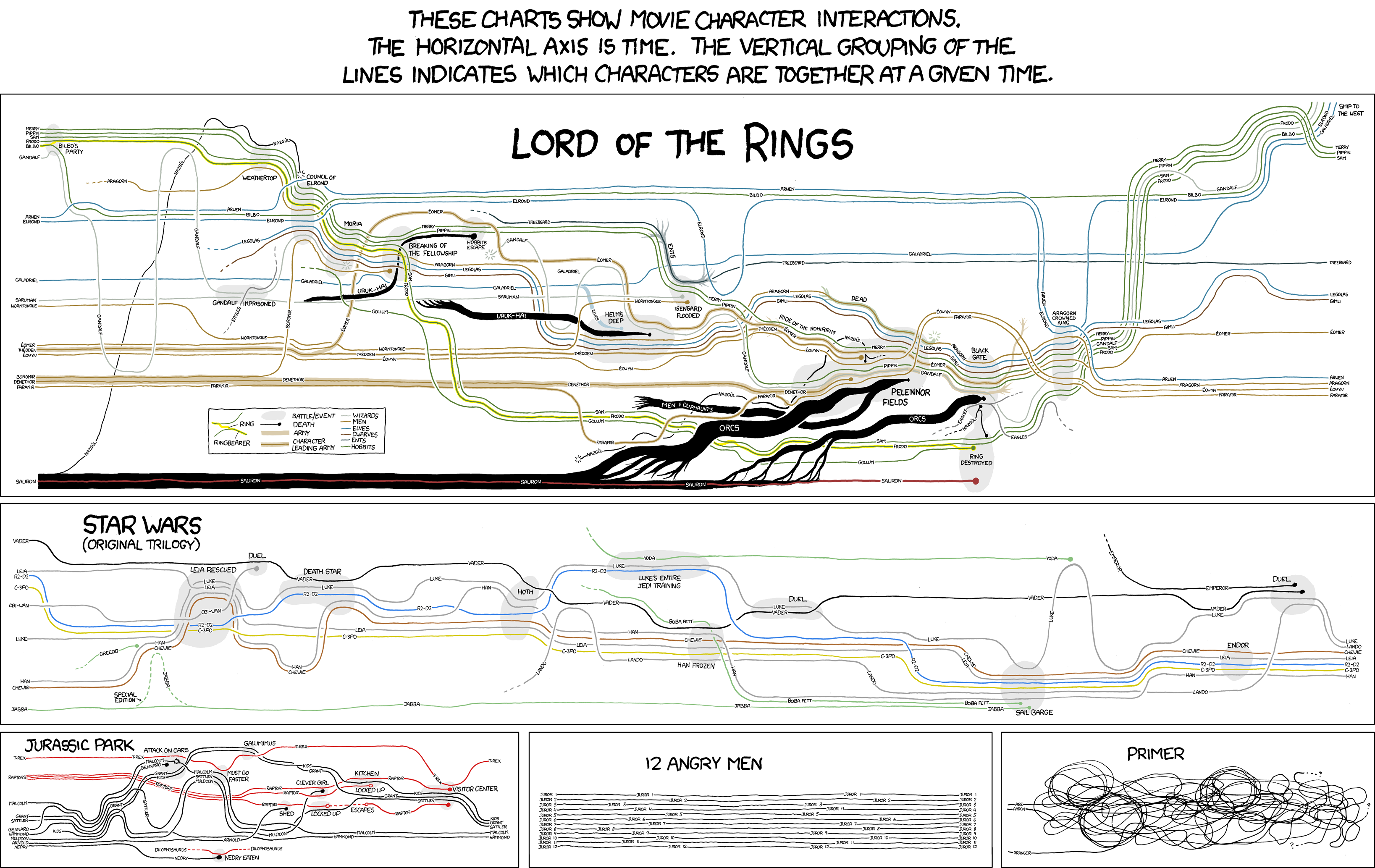
I feel like trying to resolve Primer's timeline!


Gotta love some XKCD's comics. This is one of those!


More than that, I believe the far and beyond best thing I can invest in is on moving out of this country, which means, investing in myself. But even for that, my savings are quite too little. It can buy me about a year in Germany, in which I'd need to be studying, and maybe around 1 year in New Zealand, also studying. One problem there is I don't really want to go to college now, since I can't really pay for the whole 3 to 4 years. Which is also the biggest reason why I never finished college - never had enough money. Never had enough time. Which translates to "I've never ever had enough peace of mind to actually study hard", like I did when I was young, naive and studying to get into college.

I never stopped studying, though. This year, for instance, I'm doing Computer Science on edX, with awesome courses from Harvard and MIT, which don't really add anything new to my basics, but do consolidate what I know, and introduce some new stuff such as scratch (in which I've made a little game in less than a week). Too bad it's so limited. I've always invested much time in reading and learning online, despite of any course. It's also another reason I despise most traditional schools. They're just playgrounds. But they might be my only path to get in a nice country this year and, who knows, learn a new thing or two. As playgrounds, they do work for meeting people as well, and if they're free, at least it's not "despisable" (if that's even a word).

In any case...

While I can't define a single path to follow, the single focal point anyone need to actually accomplish anything in life, I'll just keep shooting "to every side", or at least shooting to all those options I've mentioned: trying to move out; seeking a new worthwhile job; plan B; etc. I still hope I can do at least something on plan B... Some news do get me excited once in a while, but reality have always crushed my available time and mindset.


And all this could be just the tip of the iceberg, regarding my life plans and future path, thanks to the blanket! :-o

But...

If you did read it all, if you can identify even a little, if you missed no spot of this little story, and if you will, please, do leave your opinion! I'd love to hear as many opinions as possible with this question in mind: What would you do in my place?

sexta-feira, 9 de maio de 2014

Why Stack Exchange Network rocks!

Stack Exchange (SEN) is a Network of sites which uses a Question & Answer (Q&A) format in an attempt to "improve quality of the inter webs content", as they once described themselves as I recall and here adapted with my own words. It started in one of the "child" (actually the parent of all) sites, the Stack Overflow (SO), specialized in computer programming, in an attempt to "improve the quality of programming subjects in the inter webs", also as once they described themselves, etc.

I recently gained some moderation privileges by reaching 3k, which I weren't really looking for. Moderator is a tough job I never wanted. But since I was there, I decided to give it a try. While on it, I couldn't understand what people get by focusing on doing only janitorial moderation <-- so I posted that question and got some heat over it.

From that, I came to read many other things about SEN, specially experienced people talking on why the left, some saying why they would leave (but either haven't or came back soon enough), even why some people do the janitorial moderation for no game (to me, the honest answer is "because they're richer than they think and got nothing better to do", maybe I'll write about this some day), or simply some newbies talking why it sucks.

This later newbie, Serg, thinks SEN is a place to ask questions. He couldn't be more wrong. It's a place to find quality answers and, if the question have been posted already there is no reason to post a new one unless it adds something new. Duplicate questions have their value, as long as it helps people finding the same good answers. We don't think all the same way, we can't all think of the same question that will yield to the same answer.

SO practically reinvented what a Q&A site is, when it was launched, as an improvement of forums, where we used to go and look for answers. Forums were (and still are) dreadful. Flaming topics would gain pages of useless people trolling and bashing. They do serve a purpose (thus there comes Discourse), but it was a bad tool for finding answers. Regular Q&A format, such as the dead Aardvark and yahoo answers also serve a purpose, to get some kind of personalized support. I don't think we got a cutting edge service doing good in that area yet. At least, not as good as SO suddenly was for finding good answers. SO is not a tech support web site and SEN similarly isn't a place to ask questions - only good questions are accepted and that is mostly what makes them so good for finding answers!

Picture a room full of people. A forum would be a messed discussion room which someone start a topic and most will follow and give their opinions. This works for brainstorm, but not for getting answers. A tech support Q&A would be like the forum, except many would be asking the same question over and over again, and whoever feels like they can answer would come and give the same answer over and over again, though eventually a bit personalized. This works when you do need more customization, when a broader FAQ wouldn't work. Well, SEN Q&A is like a community built gigantic FAQ. In that same room, this would be like one person asking a good question, another one adding relevant info to that question and others will come in and offer their answers while everyone votes in which inputs are the best ones. This does not work for brainstorming neither for very customized questions, but boy, it sure works for most of our question and discussion needs.


Michael's experienced post (which I've already linked) was much, way much more well informed on his criticism, but I also would like to prove him wrong. He basically claims SO promotes poor pedagogy, has a bad scoring system and childish community. The scoring system is flawed indeed, but he forgets SO works. In fact, it works so well I don't think anyone can pinpoint why. There is yet to come another SEN site which works this good - even Super User, its second child, does not get anywhere close. SO has 7M (Mega, Million, 1'000'000) questions, 13M answers and 76% of the questions got answered. This is astonishing! I don't know how or why, but the SEN engines were set in place thanks to the scoring system. So until someone finds out how that works, or until it stops working, we better leave it as it is.

Sure, giving the fish isn't as good as teaching how to fish, but it's nonsense teaching how to fish without giving the fish first. You first show how it's done. Also, that's an oversimplification of the whole learning process. Hardly anyone ever become a fisherman, or a good one for that matter, by following some pre-established steps. You follow them to get started in basics and you lead from there. If you can get that base by finding a few basic answers, how's that any worse? In other words, we don't have any bullet proof pedagogic system anywhere, and most of the systems we got today are way dated, over millenias.

Finally the community is just as childish as any skeptical community, except on SEN they have community mod powers. In fact, skeptics @ SEN is the harshest community I've ever seen indeed <-- took me about 2 weeks of research to come up with that answer, and even asking questions there is harder than you might expect. We want to keep the post quality and, with that in mind, some bad things do happen. It's not an easy job to moderate it all. And it is indeed a hard place for newbies to come in. Which has a good side. It's what maintains its quality. The more abusive some mod become of its powers, the more likely it is for them losing it. That's just how a self regulated community works, and it is over time, and it will always have its flaws. That doesn't take away its merits.

And that's all reasons why SEN rocks. Great interface, big self regulated community, awesome answers. It fulfils its own purpose. Its current motto, "expert answers to your questions" could or even should be replaced by "Expert answers to the best questions".

The turning point in all the arguments I've stumbled comes from Jon Ericson's posts (not just his question, but his 2 answers there too). I think it's suffice to say the guy first loved SO then hated it, then he went away for a couple of years, give or take. Then he came back and became a moderator. Now, of course this is just 1 guy, but he's obviously not the only one. He doesn't even know why, but now he just enjoys participating in it. Well, to me it's simple: like anything in life it's hard to find your place. He struggled to find his, but he did. If it feels right, we gotta keep trying to polish up the bad stuff!

As for me, I had one reason I wanted to join the community in trying to ask good questions and give good answers: I wanted to have enough reputation so I could offer a bounty on questions that I might have and would be of great importance to me. That became a null point as I hardly ever used bounties myself.

So maybe the main reason I currently rationalize to excuse myself in continuing to participate, investing time, thus money, in something that hardly gets me any of that back (despite most of times not really having margin for such luxury) is because if I at least can one day find a great job thanks to my profile, everything will pay out instantly. And if not, well, at least I had some fun on the ride.

Just try to enjoy it, then it's easier to have no regrets! ;-)

quarta-feira, 30 de abril de 2014

Take at least 30 minutes to read this, if you want to know more about skepticism or speed reading

You may need to take a few hours if you want to know about both.

This could be my "smallest" post so far, because it could be just this link.


But since I don't like relying on links too much, because they will eventually break, I'll paste almost all of it here and then add a whole lot more...
    Take about 15-25 minutes to "read" this. Best case scenario. Speed reading won't help you here.
    TED talks to the rescue: https://www.ted.com/playlists/1/ho...    The first talk says it all needs to be said here IMHO. The brain have 1 function, and one function only: to generate movement. Don't try to understand my very short description here, go on the link and watch the first talk if you really want to comprehend this. Something around 15-20 minutes gone, until now, depending on how much of the video you've skipped without missing the point.
    We somehow adapted this amazing tool to do other stuff as well, such as calculations. It's almost like using the computer's video processors to do math calculations. It works, but you can't use both at the same time in extreme situations.
    While amazing, our brain is way more limited than some people would like to believe. It just isn't able to be quickly trained in doing something it wasn't meant to do. It is that simple. It isn't a computer and it isn't doing boolean operations.
    With that piece of skepticism in mind, you can quickly drop almost every single snake oil idea about the brain out there. Including this whole speed reading vs subvocalization and skimming idea.
    The other piece is offered by SGU: https://www.theskepticsguide.org/    Now, you either know about them already or you don't. If you don't know add, at the very best case scenario, some 2 hours to this "read", among listening to 1 episode, studying about skepticism from their point of view and, with some good coincidence, identifying the concept with one you had previously. In the worst case scenario in which you'd still get there, this could easily take years.
I meant to talk just about speed reading when I started writing that comment. But, as you can realize by the last paragraph, it inspired me into talking about skeptics.

The "skeptic" word was widely used by Carl Sagan (I like how old this link feels) in the first Cosmos voyage (which I didn't watch). Now we got a new awesome Cosmos odyssey thanks mostly (I think) to Family Guy's Seth MacFarlane, Neil deGrasse Tyson, Carl's wife and fox. In it, there is no usage of the keyword "skeptic" anywhere (at least in the first 5 episodes) anymore, as Evan observed. 

I believe that's because "skeptic" has now a wide variety of usage and many people will miss-define it as "hard minded" or something in those lines. So they will also associate it with people who don't listen, which couldn't be farther from the true skeptic, as still defined by SGU.

Anyway, skepticism is actually closely related to science. I've talked about this (in portuguese, with english translation link in the bottom, which I haven't read-proof) few weeks ago. Although it's not as closely related as we'd like, because too many self proclaimed scientists aren't really skeptics. But let's begin from the basics. I'll basically repeat some of my linked post there...

In short:
Science (from Latin scientia, meaning "knowledge") is a "systematic enterprise" that builds and organizes knowledge in the form of testable explanations and predictions about the universe. In an older and closely related meaning, "science" also refers to a body of knowledge itself, of the type that can be rationally explained and reliably applied.
To illustrate the scientific method, I love this video about "what is sea level":


The point is, defining even something that might appear as simple as "sea level" is actually far more complicated than we can intuitively anticipate. And if we don't study it hard enough, it will be defined wrongly. Going through all that tough job of doing it properly is what scientists do.

Now, there is big a danger there. A good skeptic will be a scientist by heart, and a good scientist must be always skeptic. But what is skepticism after all? If you missed my wikipedia link there (or if it broke):
Skepticism is generally any questioning attitude towards knowledge, facts, or opinions/beliefs stated as facts, or doubt regarding claims that are taken for granted elsewhere.
So, basically being a skeptic is being a curious potentially annoying kid. Thus the wrong definition many people have about it. The danger in science happens every day. Scientists forget to cast question and doubt in their fields. They often begin to think they have expertise in other fields. Science isn't easy and practically all of who have attempted showing they know way more than their narrow field of study have failed.

The scientific method shields nobody against logical fallacies. Skepticism does. But a skeptic is no scientist. A great skeptic will spend days, weeks or even months studying a subject before talking about it. A scientist will spend years or a whole life in just 1 subject (we usually associate science with physics, but that's just 1 field).

Each one have his role, and I am not either a scientist nor a good skeptic, as most of us. I just find it elucidating to realize their existence. I also think it helps me on my own personal quest while trying to understand the cosmos. And it helps to filter out the junk.

In the end, all this is just an attempt to illustrate concepts through defining words. I often find it's one of the worst methods for illustrating concepts, but ignorant as I am I know not many better practical ways. I hope you could grasp some of what I meant to transmit here.

quarta-feira, 16 de abril de 2014

Same personality test, 8 years later

I have always had fun filling up tests, especially about myself.

There is this test, Personal DNA which have been around for quite a long time and, for some odd reason, keeps getting upgraded with functions that don't work. That ATTAP company responsible for it has no contact info and no way to know what's happening there... Creating account doesn't work, to begin with its issues.


But it's still the best personality test I've ever seen! It takes about 30 minutes to complete, it's very extensive and even if you take it twice in a roll you won't have the exact same results. So it is quite subjective indeed. It also brings some typical personality info that I like to compare to horoscope. It's just a lot of mumble jumble, such as "You are well-attuned to your talents, and can deal with most problems that you face.".


 The coolest part about it, I think, is the 13 personality traits. It's represented in a weird colorful map and later dissected point by point. They claim:

Each bar indicates the percentage of test takers who entered a lower value for that trait than you did. For example, if Confidence is at 80, that means that 80% of people entered lower values for confidence questions than you did. Based on a sample of 30,000 users
If that's true, and if there is indeed enough people taking the test, that's wicked cool!

So...


My old personal dna report, from my previous blog post, says I'm a "respectful leader" and gives me this weird and colorful map (mouse over to see each color's description):


My new one says I'm a "free-wheeling analyst" and gives this other colorful map:

Almost half of my traits changed a lot over those last 8 years. Most didn't. I'd assess they are all basically true!


For the 6 big changes: seems like I'm extremely less open to new experiences than I was, this means I'm ready to choose and do stuff; a lot more extroverted and outgoing, awesome; got much much more empathy towards others thoughts and emotions, yeah baby; and trust a lot less in others, so I think now think most people aren't good at heart (nor bad for that matter), because I actually believe most people are just zombies (more on that to another blog post, maybe). I also believe much less than I already did in agency, in other words, how much me or anyone can change the future - I indeed now believe we can't, just like we can't change the past; and I became much less interested in how things look while much more interested in how things work, though I always prefered functionality over aesthetic, the previous test showed I cared much closer to 50 50, while now it's almost 0 to looks.


For the rest of 7 little changes, some of which may be insignificant: a little less confident about expressing my opinions, which I like to translate as less confrontative without necessity; little less masculinity and little more femininity, which is good because I was too extreme in both stereotypical traits before; a little more spontaneity reaching the awesomeness of being comfortable with having no plans; little less attention to style or fashion, which is quite irrelevant as I never gave any attention to how my own dressing style looks, although I eventually might; little more authoritarianism, favoring the order and the law a little more, but still not so much; and very little less earthy, or more imaginative - I've always loved theory and abstraction, but I still prefer practice way much more. Many people may find this last one weird, as many mighty say I dream too much.


What I do find bad about this and all other similar tests is exactly this... From my point of view, I got better in every single one of the 13 aspects. I worked to get better, and I did, and I'm glad to see it reflects in such a test. But, in both tests, they say I'm something awesome. How did I go from "Respectful Leader" to "Free-Wheeling Analyst"? That doesn't seem to reflect the improvement I've made, nor to reflect what I was or what I am. This whole "feel good" horoscope part of it is terrible! I'd like to see "You're a spoiled kid" result for a change, which can actually teach us in what we can or should improve to engage in social norms and / or to learn how to know ourselves.


In any case, there. That was my " having fun with a personality test" for today! :-P

sexta-feira, 4 de abril de 2014

Why is it so difficult for a technology to be simple?

Disclaimer: This is a not so long but very dense text, like most of what I write. You can't just glance your eyes to read it.

I am a former programmer, a person who proposes to work hard to simplify computer processes. And I think most of us overlook "simplicity" way too much. I know I did overlook it many times, and I probably still do, despite all my efforts.

I'm currently struggling a lot on finding a perfect and simple solution for "bookmarking", in lack of a better term. It's not just bookmarking, though, as that implies having broken links. I want no missing data. So I want to save an offline / personal copy for at least 10 years. Know when I saw it. Share it. Search with keywords or date. Browse thumbnails. Etc.

I've tried delicious, google bookmark and +1, old extinct xmarks and its new lastpass version, all those tools you associate with "bookmark". But I'm also using dropbox, calendar, twitter, youtube history, ifttt, just to give you some examples and maybe an idea of what I actually mean and what I actually want to find. Maybe there is such a tool out there, but it's certainly not associated enough with the whole bookmarking concept and I still couldn't find it after a couple of days.

For another instance, I'm also recently struggling to find an awesome text editor. Yeah. Your read it right. Text editor. Awesome one. Offline. Collaborative. Powerfull. Reliable. Clean. It doesn't exist. Not yet. Not anything close to it. When I started searching for one, I thought I'd be able to find one easily. I overlooked it.

Now going back some years... since my first smartphone, an iPhone 3GS, I can't find a phone that will give me all the simple things I want. Share files. Hear music. Record callings. Battery life. Among others. I hardly can believe how this also doesn't exist yet. Even Apple, being so good with keeping a checklist, still couldn't do it. I currently own a Moto Razr HD, which still lacks power on all "simplicity" I've mentioned there, but at least it works much better (in general) than any iPhone ever did, for those "simple" tasks. Granted, gadgets are way more complicated to build than software. I'm just trying to explain in general terms what "simple" means to me, and why it is indeed difficult to build "simple" stuff. And I think Apple, Google and even Nintendo are masters at doing that, in general.

With that, I hope you can now see there are lots of difficulties in being "simple"!

I think the most important one is: "simple" isn't opposite to "complex", which isn't synonymous of "complicated". We constantly develop technology to simplify things for us, since the first wheel or pen. But the more it simplifies, the more complex it needs to be. And building up a solid complex tool for us, highly subjective individuals, is quite complicated.

Even building something apparently as simple as a bookmarking tool is something extremely complex. Extremely. That is if you have the degree of exigence I do.

So...

If you are doing any attempt to build up technology to simplify our lives, please, take a step back. Look at the whole picture. As most of us usually do, you're also probably doing it wrong. I believe for some people all it takes to do it right is just being more careful.

For Apple, the iPhone is actually very close to the whole "simple" concept I try to explain here. But almost all of its issues are actually limited thanks to some legal issue. All, except battery. Just make a bigger phone with a smaller screen! Call it "iPhone Pro". Not everyone uses it so much, but for lot of us who do, we care about it lasting a whole day with heavy usage more than anything else.

For me, I know I'm so bad at it I just gave up on trying. Just hope this isn't too hypocritical.

quinta-feira, 27 de março de 2014

How I got my usa tourist visa denied for the 3rd time

I'd argue most statistics on getting a tourist visa here in Brazil will show there is about 97% approval rate. I wonder what's the chance of having it denied 3 times, along almost 6 years.

Imagine no countries. Just imagine. Then move on.
My latest previsions about "last time I apply for a tourist visa" are about as good as anyone else's. I never wanted to try it again, but I wasn't counting my brother would be willing to pay me to try. And I was also very surprised by how it was denied to me this time. The 3rd time.

A lot has changed on the consulate from previous time I applied about 4 years ago. Most of my web links from my previous post are now broken. The web site changed everything, seems like. The whole process did change a lot. If the current process was the same in 2006, I could have renewed my visa, which would now be valid until 2016 without even needing an interview. It's also now possible to schedule new interviews one after the other in less than a week. With that, something that was impossible is now possible: someone was denied the visa, tried again 1 week later and got it.

There's still the myth that soon Brazilians won't need tourist visa anymore. Looks like this myth might even be getting stronger, but I think it's just a myth. There's too much money on it (I've heard 3 thousand interviews per day are made only in São Paulo, costing little more than U$100 each, and lasting for a few short minutes) and new consulates are being created in other cities. There's now a third party company, CASV, which was hired only to digitalize photos and fingerprints and thus optimize the consulate performance. So, there was many improvements and investments in this whole system...

But the consulate still is like hell.

I was there by 12:30, had my interview scheduled to 13:00 and only got to talk at 14h. Line after line. We can't even bring a cell phone turned off, not even a headset is allowed. No kind of gadget. If you don't want to talk with people in line nor die in marasm while standing on the line, bring a paper Sudoku. Also bring an umbrella because in some lines you may have no roof.

I still believe the main factor to approve or deny a tourist visa are their own data. In my case, I still have what they would call an extremely weak link (no job, no university, no cars, no house, etc) to Brazil and, to my first surprise, the interviewer justified in the end I also had way too strong links in the US (mother and brother).

It matters not I had traveled to several European countries and to New Zealand. And I came back. It matters not I'm in a very stable union for 5 years with a beautiful woman and she's very well employed here for at least 6, and I have not the slightest intention on divorce. Seems like such a union means nothing in the US. I've learned if you live together with your mate for 2 years, you're married for all legal means. And I do call her my wife.

It seems to also matter nothing I once had a tourist visa and I was legally in the US for 1 year and I came back - to keep it legal. I've worked there and my boss promised a work visa, which didn't happen.

I had 2 big reasons to believe this time would be different.

First, my brother sponsoring me. Not just paying the "small" fee, but also taking full responsibility for my stay. What else the US need? I had a tax paying US citizen willing to take all legal chances for me. This was huge to me but, to the consulate, it matters not. Or maybe they didn't know that much about him, as I thought they did...

The second reason actually mattered. Negatively. Once again, I've set my mind to "tell as little as possible". With that, I decided to try and simplify my whole "1 year legal stay", because I once believed this could have been an issue in the previous attempts. I'm not sure how simple of a process it is. So, this time, I said I was there for 1 month. I lied. And I kept on doing it - short and dry. He would ask "how long you stayed the last time" I said "1 month". Later on, near the end, he asked "how long you stayed there again?", I said "1 month". "Are you sure?". "Yes.". Smooth. I'm a dumbfuck.

That was just the way I rationalized how to simplify my story, keep it short. My previous interviewer would probably have asked to see the papers I had brought, once he realized how bad I sell myself. I had all money information they needed there and a signed letter from my brother proving his will to sponsor me. But I didn't show it to him. And he didn't ask. After that, he just told me "Your visa was denied, you got too strong links there, too weak links here, and I know you stayed there for 1 year so you weren't cooperating with me".

"Do I have any say on that?" I asked. Still on the fucking programmer mindset of being short, concise, trying to communicate with someone like me. But I'm not normal. I don't really "get" people. I got many reasons I want to leave my country and one of them is I don't connect with so much lack of caring. People here don't care about other people. I care a whole lot more than you, my dear reader, probably ever did or will. I'm stupid like that. He said "no, it's done". I left. Stupid again.

There. I had my tourist visa to visit "the most armed country in the world" denied for the 3rd time.

Look, I know that's his job. I know he interviews hundreds of people per day. I know it's humanly impossible to be fair with everyone there. But he took that job. He wants to be that guy. He knows he will be unfair to a lot of people. And he doesn't care. He didn't look me in the eye, once. He didn't try to see my point. He didn't bother to help a honest human fellow just trying to be free. After all, why would he care?

I also know I lied. But he didn't know that for sure. No matter what technique he used, he can't know for sure. Proof of this is the number of bigger liars that get approved through the same process, and go on to immigrate illegally. He basically called me a liar, without knowing for sure. And gave me no explicit chance to reply. That is just terrible work for U$100. Terrible.

I'd go as far to say this whole process is committing a huge crime against the US of A, staining the country, the human race even, and also making enemies for no good reason. It's not like this process is properly filtering illegal immigrants. It isn't. So I don't know why it exists, but I know in my skin it is making enemies. I've met that feeling of hate there. I believe there is such a thing as verbal and emotional violence and it is considered a crime, isn't it? Maybe I'm wrong...

In any case, why not paying more attention to these small things?

Despite all of that, this time I didn't hate that guy behind the glass wall. I hated myself. He made me feel miserable. I made me feel miserable. I think I only got denied this time because of my own lack of communication ability.

Best advice I can give to anyone who is trying all this: First time applying? Got family there? Lie your ass off and relax. Do not be nervous. They're not that good to identify lies, most of them won't even look into your eye and they use very old techniques to try and make you nervous. And if you do get nervous, they'll likely assume you're lying. That's their parameter. Also, apply the tourist visa before you apply for a green card from your family. Else, you won't be able to visit them until the green card comes. Retarded? Yes. Welcome to Sao Paulo US Consulate.

For all rest, like in my case, just talk to any specialist, such as this: http://www.vistos-americanvisa.com.br/site/

I think if I went on and tried again, I might be able to get lucky with a better interviewer and I might be able to express myself better, show my documents, say "Yeah I do have strong links, reason why I want to visit them! Yeah, I do not have a car nor a house in my name, but since when those are strong links? How many 'tourists' who do have those and you approve are now illegal in the US?", and that might be enough. It would make a great story.

But I also think it's just not worth even 1 buck trying again. I love my family, and I still love my planet with all problems it has (resumed to a lot of terrible human beings). And, as such, I now think I have to stand a point to never support this moronic consulate again. The whole process is way too expensive in every sense of the word.

After all this info, if you know you can get it the first time, and you really need to go to the US, I suggest you go and try. You probably will be just fine. Else, just choose another place to go. Most countries aren't this hypocritical. They actually give us the freedom to come and go.